AI First

AI that works with you—not just responds

Schedule an appointment
Trusted by leading companies Capterra 5 Sterne Bewertung
thyssenkrupp logo

What sets SIMPL apart

Most AI features in customer service software work on the same principle: you type a question into a chat, and the AI provides an answer. This can be useful—but it requires the user to take the initiative, ask the right question, and verify the answer.

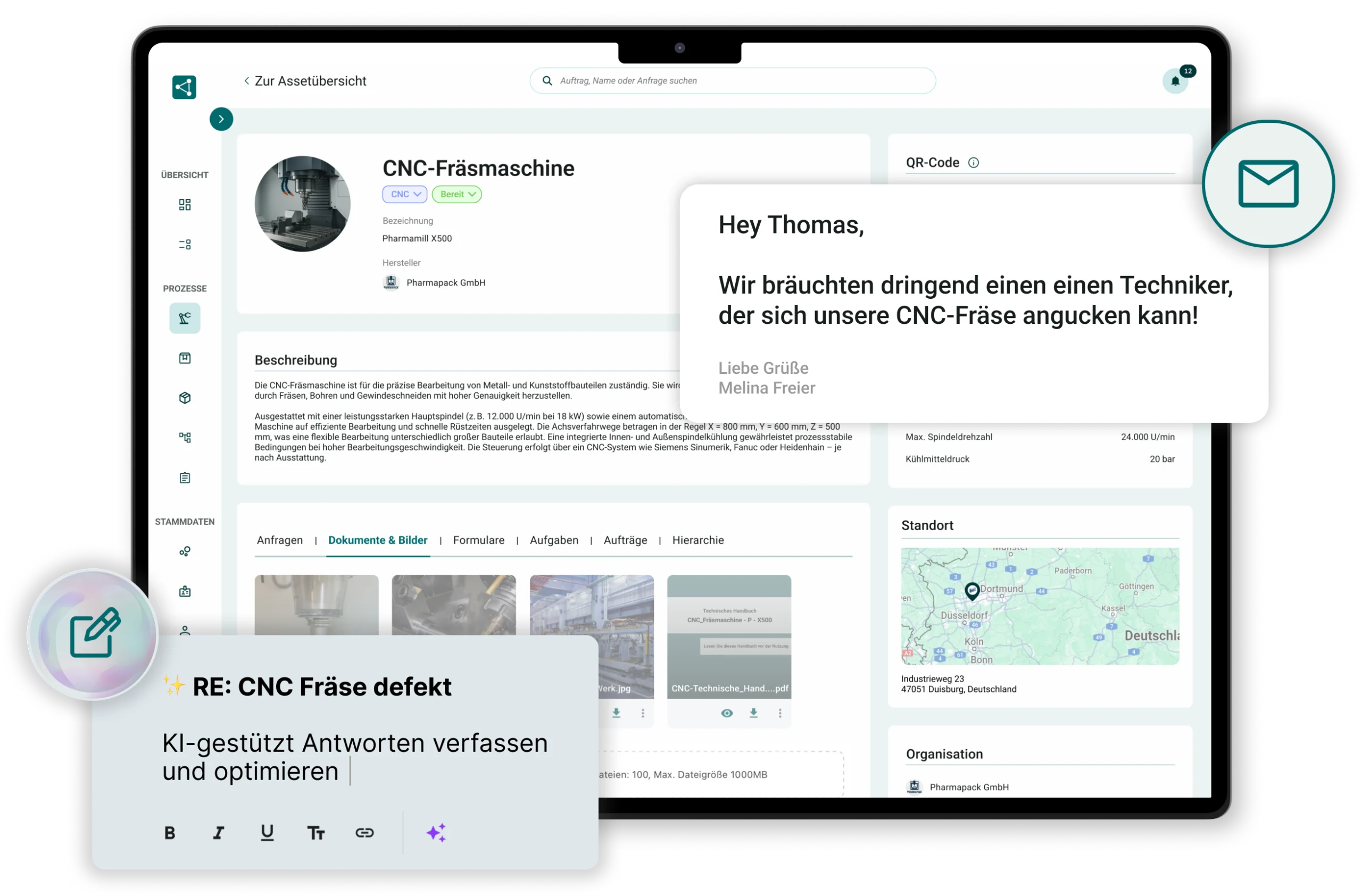
SIMPL takes a different approach. The AI in SIMPL is directly embedded in workflows and operates automatically—without anyone having to type a prompt. When a ticket comes in, it’s already tagged and prioritized. When an email arrives, a suggested reply is ready. When a service call needs to be scheduled, the AI suggests the right technician. When a technician returns from a service call, they dictate the report into their phone.

The goal isn’t to give the team yet another tool. The goal is to take work off the team’s hands—automatically, for every single task.

AI in Ticketing & Customer Service

The problem: Service teams handle dozens or hundreds of requests every day—via email, phone, or the customer portal. Every request must be read, categorized, prioritized, and answered. This takes time, and when volumes are high, urgent cases get lost in the mix.

Automatic Tagging & Prioritization A new request comes in. Before an employee opens the ticket, SIMPL has already analyzed it: machine type identified, inquiry type classified, urgency assessed. The ticket is tagged and prioritized—automatically, for every single incoming request. Urgent cases are immediately moved to the top, while routine inquiries are neatly sorted.

AI First-Response Draft A customer asks about the maintenance interval for their system. SIMPL cross-references the inquiry with the ticket history and the machine file and suggests a response. Your team reviews it, makes adjustments if needed, and sends it—instead of writing every response from scratch. This saves a significant amount of time, especially for recurring inquiries such as spare part requests or status checks.

Ticket Summary A service case has 47 messages, 3 people involved, and has been active for two weeks. A new colleague takes over. Instead of reading through the entire history, they click “Summarize”—and get the key points in three sentences: What happened, what’s the current status, and what’s next.

Real-time Email Translation Your engineer writes in German, and the customer in Shanghai reads it in Chinese. Your sales colleague replies to a customer in France—the email is sent in French. Automatically, without a translation tool. For mechanical engineering companies with an international client base, this eliminates a daily source of friction.

AI in Operations Planning & Scheduling

The problem: The dispatcher assigns technicians to jobs—taking into account qualifications, location, availability, travel time, urgency, and machine knowledge. With 10 technicians and 30 open orders, this is a puzzle that must be solved anew every day. Last-minute changes—sickness, cancellations, emergencies—throw the plan into disarray.

AI Dispatching A new assignment needs to be scheduled. The AI analyzes all relevant factors—qualifications, current location, workload, machine knowledge, open orders—and suggests the optimal assignment. The dispatcher reviews the suggestion and can accept or adjust it. In the event of last-minute changes, the AI recalculates the schedule in real time and displays alternatives. No manual puzzle-solving, no restarting with every schedule change.

AI Route Optimization For technicians with multiple assignments per day, the AI calculates the optimal sequence—based on locations, time windows, and urgency. Less travel time, more assignments, lower costs. Especially for teams with 4–8 assignments per day—HVAC companies, refrigeration technicians, elevator service—this is a direct boost to productivity.

Automated Service Call Briefing Before each service call, the AI compiles a briefing that includes the machine’s history, recent maintenance records, open tickets, known issues, and relevant documents. The technician arrives at the customer’s site fully prepared—without having to do any research on their own. This saves 10–15 minutes per service call and increases the first-time fix rate.

AI in the Field – On-Site Documentation & Analysis

The problem: After a service call, the technician has to write a report. In practice, this means sitting in the car at night typing away, filling out forms from memory the next morning, or—in the worst case—forgetting to write the report altogether. Documentation suffers, and the office staff is left without the necessary information.

Voice-to-Report: Speak into your cell phone for two minutes, and SIMPL generates a structured service report—with the correct fields, timestamps, and machine assignment. No typing, no forms, no follow-up the next day. The report is ready before the technician even starts the engine. We are currently working on Voice-to-Report.

AI in Knowledge Management & Analysis

The problem: Experienced technicians keep their knowledge of error patterns, solutions, and machine-specific details in their heads. When they retire, that knowledge goes with them. It takes new employees months to reach the same level of expertise. At the same time, data volumes are growing—but analyzing that data remains time-consuming and manual.

AI Knowledge Base The AI knowledge base is automatically built from closed tickets, service reports, and documentation. When a new ticket with a similar fault pattern comes in, SIMPL suggests the solution based on past cases. New employees find answers before they have to ask—and the team’s knowledge remains in the system, even as personnel change. We are currently working on the advanced stages of the knowledge base.

Pattern Recognition & Predictive Maintenance SIMPL identifies recurring error patterns in service data and issues warnings before a machine fails. If a specific pump exhibits the same error pattern every 8 months, SIMPL suggests preventive maintenance—before the customer even calls. This reduces unplanned downtime and transforms the service team from a firefighter into a strategic partner.

Natural Language Dashboards Instead of complicated filter menus, you simply ask a question: “How many service calls did we have at thyssenkrupp in March?” or “Which machine had the most malfunctions last quarter?”—and you get an answer in the form of a chart, table, or number. Make data-driven decisions without having to consult a BI expert first.

Why this is relevant now

The shortage of skilled workers in German industry is very real. Experienced technicians are retiring, it’s hard to find new talent, and the demands on documentation and response times are increasing. AI doesn’t solve this problem—but it takes the pressure off existing teams by handling the very tasks that take up the most time: sorting, planning, writing, searching, translating, and analyzing.

SIMPL uses AI where it measurably saves time. Not as a feature for the product brochure, but as a tool that takes the pressure off the team.

Data Protection in AI: The AI in SIMPL processes data exclusively within your SIMPL workspace. No data is shared with third parties or used to train external AI models. All processing is carried out in compliance with the GDPR within the EU.

→ Learn more: Made & Hosted in Germany

Close Menu